
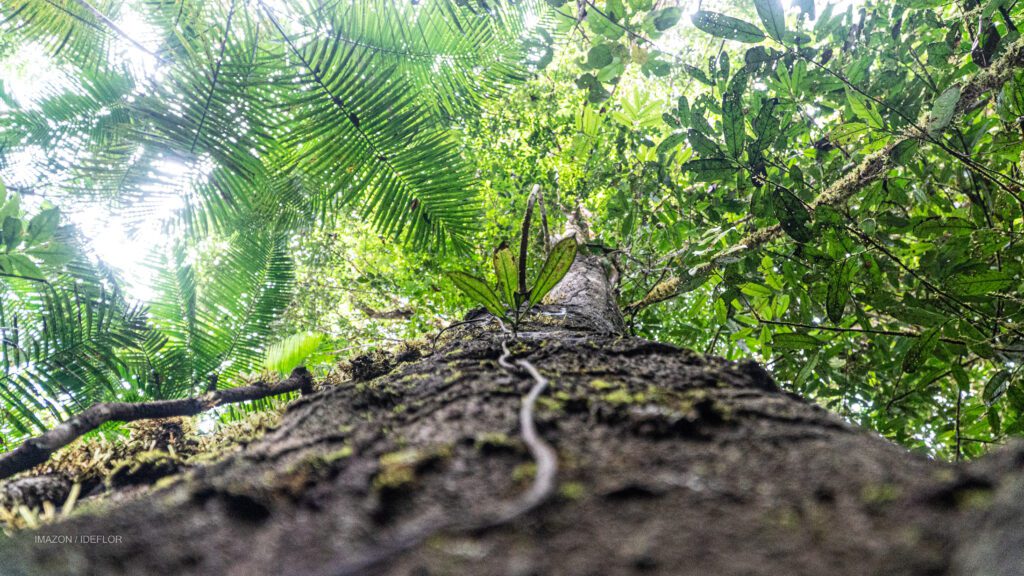
The Giant Trees State Park, created by the Pará state government in 2024 to protect the largest tree in Latin America, has yet to materialize. A technical note sent to the Public Prosecutor’s Office calls for action to protect the natural heritage.
Alexandre Mansur and Angela Kuczach*
In 2022, Brazil was shocked to discover that the largest tree in Latin America was in its backyard. An 88.5-meter-tall angelim-vermelho (Dinizia excelsa), located in the Paru State Forest, in northern Pará state. The reaction was immediate, exciting the scientific and environmental community, and with intense pressure from civil society, two years later, part of the State Forest— a Sustainable Use category of Protected Area, that allows the extraction of timber from its interior—was transformed into the Giant Trees State Park, with almost 600.000 hectares.
Announced with great fanfare, both during the public consultation for its creation and and on stage at the Global Citizen Festival in New York by Governor Helder Barbalho himself, the creation of the UC brought two main elements: the protection not only of the giant angelim tree, but also of an entire sanctuary of giant trees, and the economic improvement of the municipality of Almeirim (Pará) and its neighboring Laranjal do Jari (Amapá). The region is deprived, especially after the crisis that hit the region’s main employer in 2023, a pulp company, leaving approximately 4,000 of the region’s 20,000 residents unemployed. The idea of having the Park as a driver of development brought hope to the population.
Almost a year after the park’s creation and less than four months before COP30, the Giant Trees State Park remains without effective implementation. The area is managed by IDEFLOR-Bio, the state agency responsible for the Protected Areas of Pará, but the park shares a single manager with three other Conservation Units, which together total approximately 7 million hectares.
Behind-the-scenes information reveals the existence of a tourism project for the region, expected to be announced later this year during 30th Conference of Parts from Climate (COP-30), which would include long-distance trails, access to the giant tree region, and more. The initiative is ambitious and fulfills the promises made during the park’s creation process. However, at this point, it appears to be far removed from the Protected Area’s reality, as enforcement efforts remain deficient in the conservation unit.
The region is known for its significant threat from mining, land grabbing, and deforestation. Indeed, during the public consultation, miners were present, positioning themselves as the “informal mining sector” and demanding explanations for the creation of the Protected Area. In 2022, through the “Protect the Giant Trees” campaign, civil society called for greater attention to the Giant Angelim As a result, approximately 500 illegal CARs (Rural Environmental Registry) in the area were canceled by the Pará State Government. In 2024, the same campaign again called for greater protection for the region, which culminated in the creation of the Giant Trees State Park.
Now, once again, the organizations are coming together to demand effective protection for the Protected Area, not only with the (necessary) implementation of the Park, but also with concrete and ongoing investments in its effective protection. It is estimated that less than 1% of the Amazon’s giant trees have been identified to date. Without concrete protection measures, the risk is that many of them will disappear without ever being discovered.
On July 17th, Forest Protection Day, the lack of effective public policies to protect the Amazon’s giant trees reinforces the contradiction between environmental discourse and the region’s reality. The date reminds us that protecting forests isn’t just about creating a Protected Area, but also implementing it and ensuring that unique species, like the red angelim, continue to exist so we can learn about them before they disappear.
To encourage the protection of the species, civil society organizations are sending the Public Prosecutor’s Office a Technical Note prepared by environmental organizations highlighting the urgency for the Pará government to fully implement the Giant Trees State Park, with a management plan, management council, dedicated team, and oversight, but also including necessary actions for the State of Amapá, so that it can advance in the legal protection of the red angelim.
In November, the eyes of the world will be on the Amazon, during COP-30, and expectations of announcements for more protection of the forest are created almost daily. For the giant trees, however, announcements are expected not only about the beautiful part of the project, but that they truly represent a legacy, with guaranteed resources for the protection of this natural heritage, which we are only now beginning to know.
Alexandre Mansur, Instituto O Mundo Que Queremos
Angela Kuczach, biologist, advocacy specialist
Photo: Havita Rigamonti/Imazon/Ideflor
